Harsha Bhogle Turns a Post-Match Moment Into Something Genuinely Human
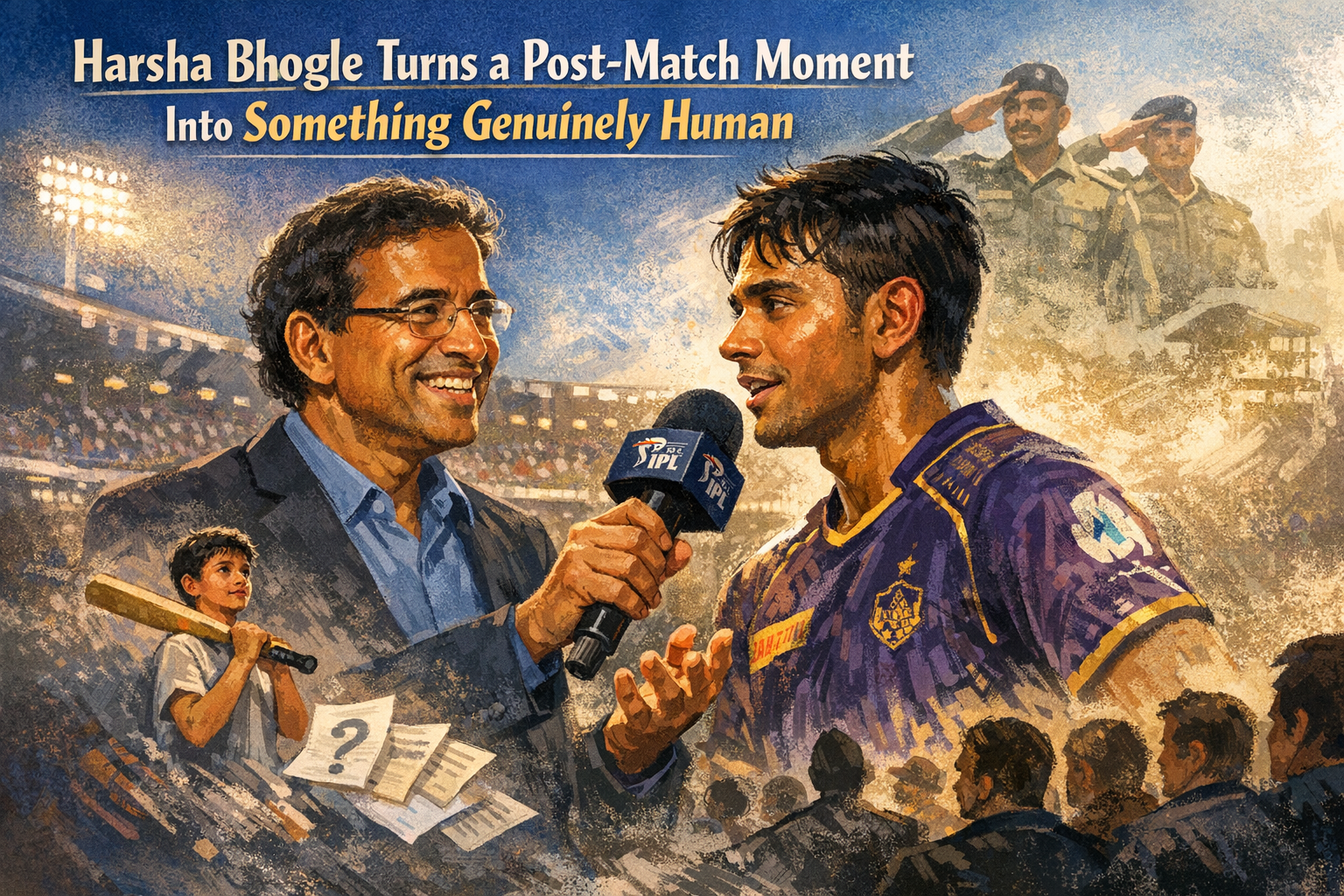
When Mukul Choudhary walked into the post-match presentation after an extraordinary performance against Kolkata Knight Riders, it was veteran commentator Harsha Bhogle who made that conversation worth watching. What followed was not a routine exchange of pleasantries between a broadcaster and a young performer — it was a window into what skilled, empathetic interviewing can do for an audience hungry for meaning beyond the visible spectacle.
The Art of the Question That Actually Lands
Bhogle's interview with Choudhary stood apart for one central reason: it was built on genuine knowledge. He arrived knowing where Mukul came from, understanding the cultural backdrop of that place, and drawing on that to frame a comparison that felt earned rather than decorative. Bhogle pointed out that the region Mukul hails from has a long tradition of individuals joining the Indian armed forces — and that Mukul carried something of that spirit in how he absorbed pressure and delivered under it.
That kind of observation does not emerge from a briefing sheet alone. It reflects the intellectual preparation that separates a skilled interviewer from a capable one. Bhogle has spent decades studying people as much as performance, and it shows in the way he constructs a question: not to embarrass, not to generate controversy, but to reveal something real about the person in front of him.
Mukul's response was equally direct. He said that pressure is something that either makes a person or breaks them. That is not a polished media line — it is an honest articulation of how high-stakes performance psychology actually works. The fact that Bhogle created an environment where that kind of candour was possible says as much about the interviewer as it does about the interviewee.
Why Post-Event Conversation Carries Disproportionate Cultural Weight
Broadcasting has evolved considerably over the past two decades, with production values rising and content fragmented across screens and platforms. Yet the live, unscripted interview — conducted with real stakes, real emotion, and real time constraints — remains one of the most compelling forms of communication in public life. It cannot be edited for safety. It cannot be algorithmically optimised. It depends entirely on the interviewer's ability to read another human being in real time and ask the right thing at the right moment.
This is a skill with diminishing practitioners. Most post-event conversations default to formula: describe what you did, credit others around you, express gratitude. The ritual has its place, but it rarely produces anything memorable. What Bhogle consistently manages — and demonstrated again in this exchange with Mukul Choudhary — is the capacity to pierce that formula without being combative. He finds a thread, pulls on it gently, and allows the subject to arrive at something genuine.
That quality matters well beyond the context of any single broadcast. At a time when public discourse is increasingly shaped by prepared statements and managed narratives, the spontaneous interview conducted with intelligence and warmth functions as a kind of corrective. It reminds an audience that the people they watch are complex, feeling human beings — not curated personas performing for a feed.
Choudhary's Moment and What It Reflects About Younger Voices Under Pressure
Mukul Choudhary's situation entering that conversation was not uncomplicated. He had delivered when experienced senior figures around him had not. That is a particular kind of burden — one that requires a young person to carry visibility without the protection of an established reputation. The way he spoke about pressure, and the clarity with which he articulated his own experience, suggested a psychological maturity that does not always accompany raw ability.
Bhogle's framing of the soldier analogy gave Mukul's composure a cultural and emotional context that the numbers of his performance alone could not. It acknowledged something beyond output — it acknowledged character. That is what the best interviews do. They do not merely document what happened. They offer a lens through which an audience can understand why a person rose to a moment, and what it cost or meant for them to do so.
Bhogle's Enduring Contribution to the Language of Broadcast
Harsha Bhogle has long been considered among the finest voices in Indian broadcasting, and his reputation rests not only on fluency or phrasing but on a quality that is considerably harder to define: he listens. In the Mukul Choudhary exchange, this was visible in every follow-up — he did not move to the next question while the previous answer still had something left in it. He stayed with the emotional texture of what was being said.
That is the difference between an interviewer who conducts a segment and one who creates a record. Long after the specific circumstances of any given evening are forgotten, the conversations Bhogle has built remain vivid because they were built around people rather than around outcomes. The IPL season this year has offered many dramatic moments in the middle. But it is exchanges like this one — honest, warm, and intelligently framed — that give those moments a longer life in memory.